

How can two people experience the same event yet respond to it in two drastically different ways? It’s as if they have experienced two different events.
We see this play out in our lives daily because our attention brings reality into existence. What we pay attention to we see clearly and what we don’t simply fades into the background.
Who we are determines how we see and in turn what we find. Attention is how our world comes into being for us. It is a profoundly moral act. – Iain McGilchrist
The mechanics of perception and why believing is seeing
Your eye doesn’t just function like a camera that captures images; it acts as a floodlight that illuminates your body and lights up your way.
Jesus in Matthew 6: 22-23 paraphrased
If your eye is focused and undivided, your whole being will be flooded with light.
But if your eye is distorted by hidden agendas or clouded by greed, your entire existence will be dark and empty.
If the light within you is actually darkness then how profound is the void?
Jesus and the woman caught in adultery
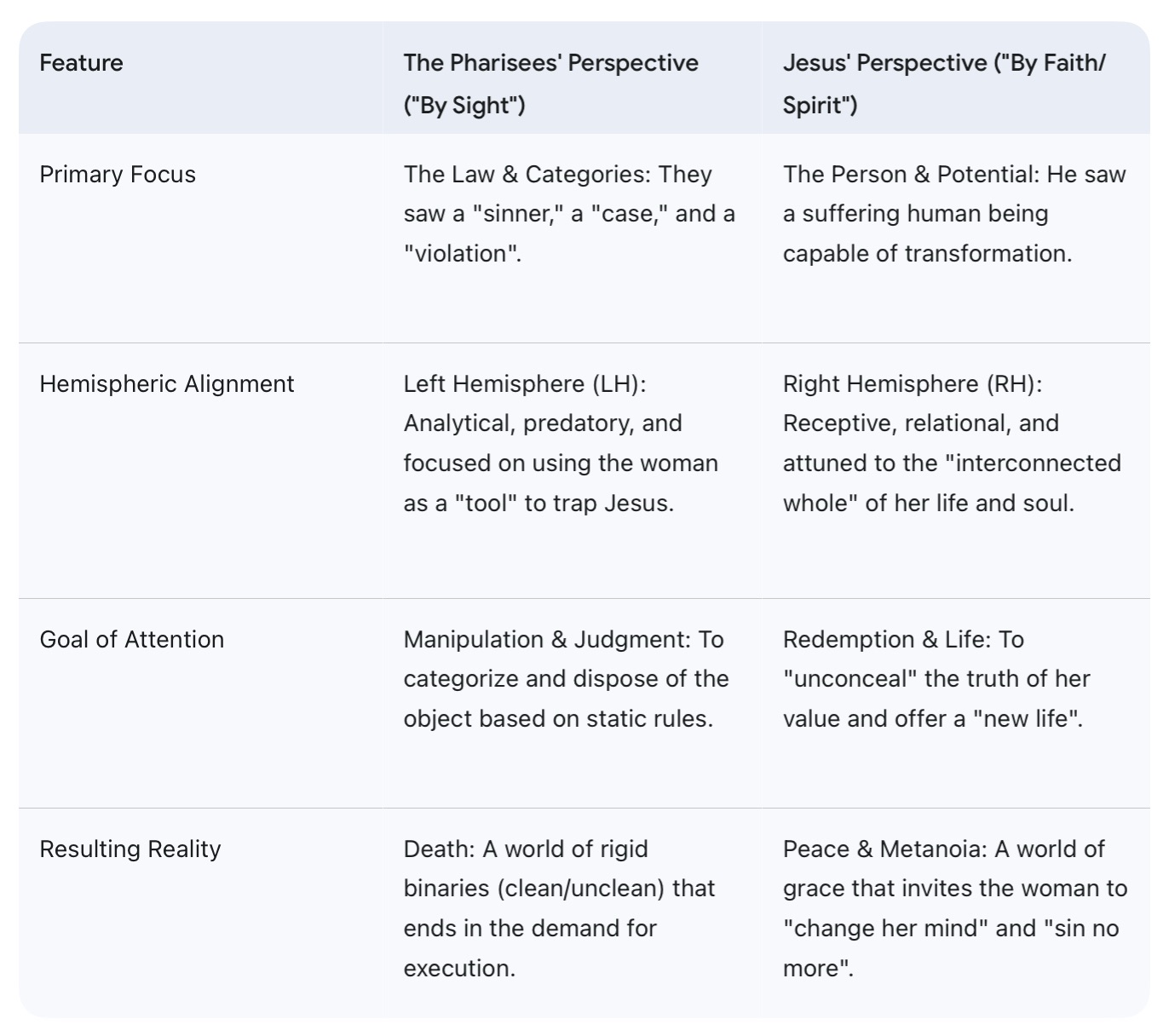
The story of the woman caught in adultery and brought to Jesus in John Chapter 8 showcases how these two vastly different ways of paying attention or seeing determine what you find.
In this story we see a perfect collision between the two “ways of seeing” as different as night and day.
The Pharisees demonstrate their narrow and legalistic way of looking at things. This is the same like anyone today who is fixated on an ideology, whether it involves God or not.
Jesus meanwhile is able to step back and take a wholistic view of the situation and see the woman as a person caught in a trap who is valuable and capable of transformation.
Two ways of seeing one woman
This chart illustrates how the same physical scene was interpreted through two entirely different set of eyes, the Pharisees and Jesus.
Why this matters
According to cognitive scientist and lecturer, John Vervaeke, how we “frame” our world determines what we find meaningful (relevance realisation).
- Perspectival Knowing: This passage is the ultimate lesson in perspectival knowing. The “Eye” is your perspective. If the perspective is aligned, the “Body” (your entire lived experience) follows suit.
- The “Darkness”: When Jesus says, “If the light in you is darkness,” He is describing a state where your very mechanism for making sense of the world is corrupted. You think you are seeing clearly, but you are actually blinded by your own internal filters.
Jesus’ teaching about the “eye” invites self-examination, openness to broader truths, and attentiveness to the things that truly matter. These principles would also apply to how we deal with opposing worldviews and cultures today.
If our frame is broken, then we cannot see the Sacred even if it is right in front of us.
