

“Whoever wants to be my disciple must deny themselves and take up their cross and follow me.”
Jesus in the Gospel of Matthew chapter 16 verse 24
Over the years I have noticed something that unsettled me more than any theological argument: How the self had taken centre stage in Christianity.
Christians don’t seem any different from secular people. Not worse, necessarily — just not other. Selfish in the same ways, headstrong in the same ways, and above all, endlessly interested in winning an argument about who has the truth.
I’d lived through both ends of that argument. I grew up under legalism — a faith of rules, boundaries, and the pride in knowing the truth. It was clear to me who would be saved and who was headed straight for hell.
Later I passed through the prosperity gospel, where the legalistic boundaries dissolved into the welcoming promise: God wants you to be prosperous. Health and wealth were treated as part of the divine reward for every believer. Financial success was seen as proof of God’s favour while suffering a result of spiritual failure or punishment.
On the surface these looked like opposite ways of looking at the cross. One demanded self-denial as performance; the other offered self-fulfilment as reward. But underneath both was the focus on the self not Christ or the cross.
Two extremes but the same self on the throne

That’s the question I would like to explore in this post: what happens to Jesus call to take up your cross when it’s received by a self that has been trained, by the whole shape of modern life, to treat its own feelings as truth.
Psychological Man and the Triumph of Feeling
Philip Rieff saw this coming further out than most. In The Triumph of the Therapeutic (1966), he traced a succession of characters the West has asked us to become — each one answering a different question about what a life is for.
Rieff’s four characters
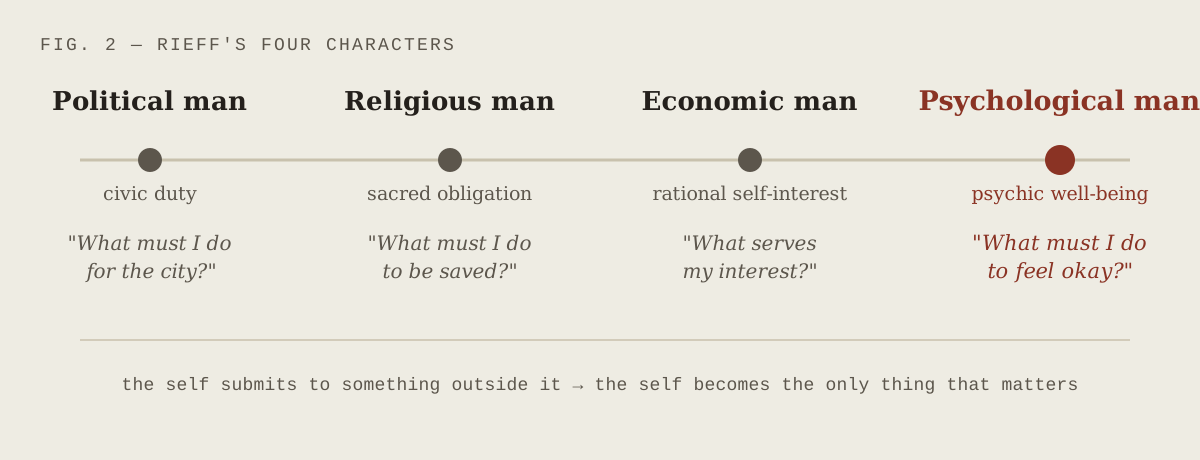
Religious man asked “what must I do to be saved?” while psychological man asks “what must I do to feel okay?”. The first question submits the self to something outside it. The second makes the self the only thing that matters.
Charles Taylor gave this shift a name that has become almost a shorthand in cultural criticism: expressive individualism. On this view, each person has a unique inner truth, and the highest moral task of a life is to discover that truth and express it outwardly without distortion from external authority — family, tradition, church, or God. Authenticity replaces obedience as the cardinal virtue.
And Alasdair MacIntyre, writing on the collapse of shared moral language, described the resulting posture as emotivism: the quiet assumption that moral claims are ultimately just expressions of personal preference dressed up as argument. Not “this is true,” but “this is how I feel,” offered with the confidence of a first principle.
Put those three together and you get a self trained from the inside to treat feeling as evidence, preference as morality, and inner comfort as the measure of whether something is good. That self does not have an easy time with a cross.
The Media Acceleration Engine
Rieff, Taylor, and MacIntyre were describing a slow cultural current. But something changed the current’s speed. For most of history, ideas drifted. Then came mass media, television, cinema, the smartphone, social media and now AI, each one adding speed and force. The drift became a tsunami: available on every screen, with the algorithm tailored for each of us.
Saturation, not just drift
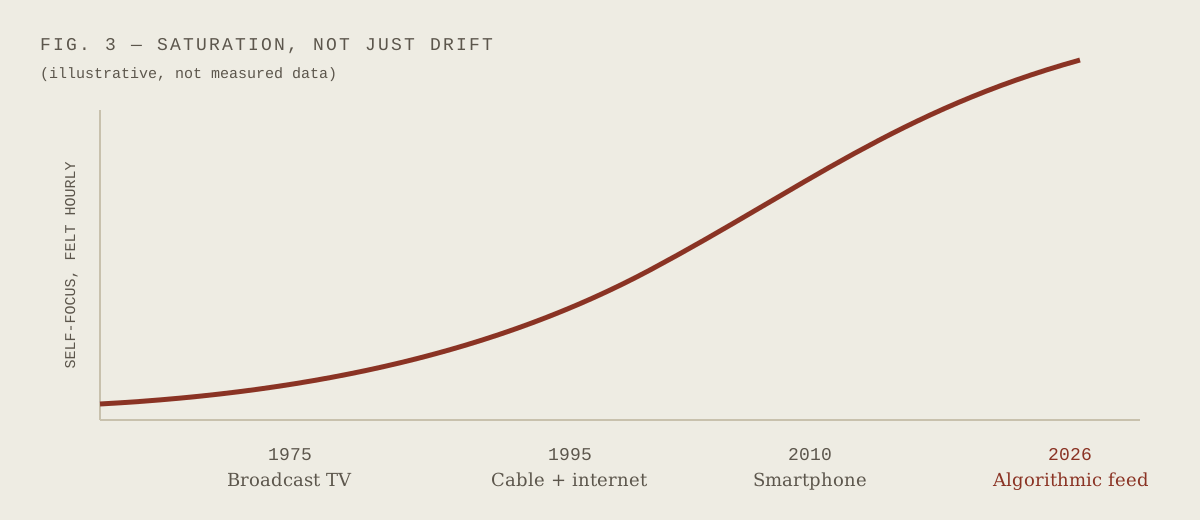
Television taught a whole culture to relate to itself as an audience watching a performance, with feeling as the metric of a good show. Marshall McLuhan‘s insight that the medium is the message applies with full force here: a culture saturated in broadcast and then social media doesn’t just receive therapeutic content, it is formed by the medium into a therapeutic shape, regardless of content. The feed doesn’t ask “what is true?” It asks “what moves you?” — and rewards, with attention and dopamine, whatever answer produces the strongest inner reaction.
Neil Postman saw the early stages of this and called it amusing ourselves to death; he didn’t live to see the smartphone turn that broadcast relationship into something each of us carries in a pocket and checks a hundred times a day.
Where psychological man once emerged over a generation through therapy culture and shifting social norms, the digital self is formed continuously, from childhood, by an environment engineered to make emotional reactivity feel like self-knowledge.
A teenager today doesn’t discover expressive individualism as an idea — he or she is trained into it hundreds of times a day by the smartphone that treats their feelings as the most important data point in the room.
What Happens to “Take Up Your Cross”
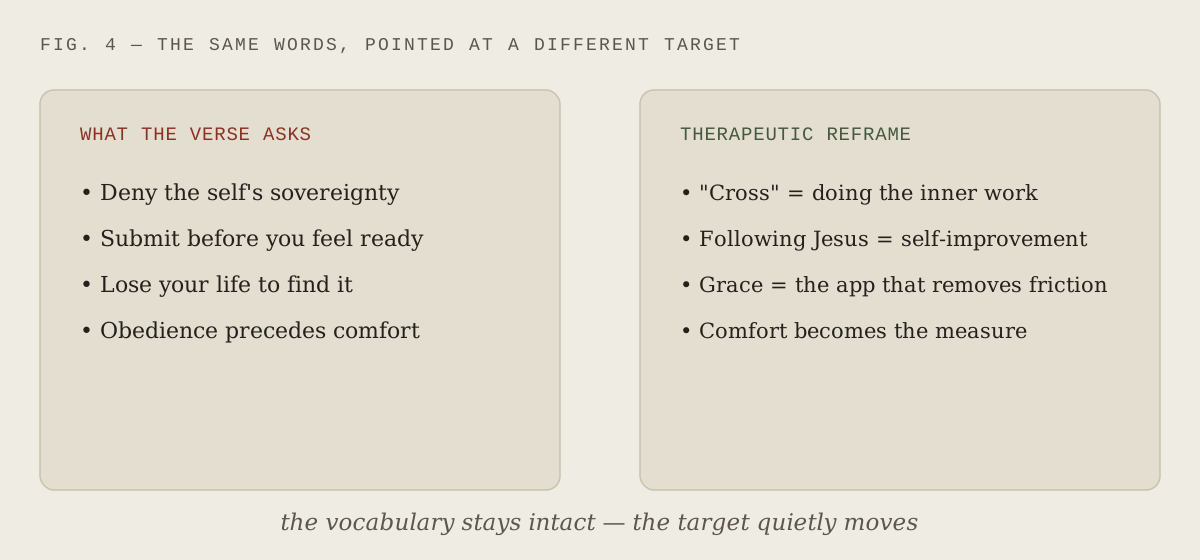
The call in Matthew 16 was never ment to be gentle. It asks for self-denial before self-discovery, submission before self-actualization, and a willingness to lose your self as the very condition of finding it.
That’s not a hard teaching because it’s ancient. It’s hard because it directly contradicts the logic of psychological man.
So our postmodern therapeutic culture doesn’t usually attack the verse. It’s far more effective than that — it reinterprets it.
The same words, pointed at a different target
The Main Challenges
A few things make this especially hard to see from inside the therapeutic church.
The vocabulary survives the substitution. We still say “cross,” “surrender,” “die to self” — the words haven’t changed, only what they point to. That makes the drift almost undetectable without real scrutiny; you can preach an entirely therapeutic gospel using entirely orthodox language.
Feelings have become epistemically privileged. In a culture shaped by emotivism, “I feel unsafe” or “this doesn’t sit right with me” functions as a conversation-ending argument, even in contexts — discipleship, correction, repentance — where the whole point is to override how something feels for the sake of what’s true or right. This makes any teaching that asks for discomfort structurally suspect before it’s even heard.
The self-help industry and the church now share a customer base — and increasingly a vocabulary. “Boundaries,” “self-care,” “your truth,” “healing journey” — genuinely useful categories in the right register — flow easily into a spirituality where God exists to support my flourishing rather than to reorder it.
How We Respond
I don’t think the answer is nostalgia for the past. I think the honest answer is that the call was always going to be this hard, and the work is to let it be that hard again.
That starts with recovering both the vocabulary and practice of self-denial that doesn’t apologise for itself — teaching, plainly, that the Christian life asks for the death of the ego self’s sovereignty over its own preferences, not merely the management of the self’s discomfort.
It means distinguishing carefully between genuine harm, which calls for real boundaries, and mere inconvenience to the ego, which is often exactly what we’re called to absorb.
It means practising forms of obedience and submission — to Scripture, to a community, to a rule of life — that don’t wait for our feelings to catch up and agree first. And it means being suspicious of any spirituality, mine included, in which the self somehow always ends up affirmed at the end of the process.
None of this is a return to legalism. Legalism was never actually self-denial — it was self-assertion wearing denial’s clothes, the self as its own judge and jury.
The cross asks for something legalism never delivers: an actual death, not a performance of one. What I’m describing is harder than either of the two extremes I lived through, because it can’t be gained by pride or comfort. It asks the self to actually step down from the throne.
That’s the faith I’m interested in now. Not the one that makes me feel better, and not the one that makes me feel superior but the one that asks me to take up my burden and move forward.
Further reading
- Carl Trueman, The Rise and Triumph of the Modern Self (2020)
- Philip Rieff, The Triumph of the Therapeutic (1966)
- Charles Taylor, Sources of the Self (1989)
- Alasdair MacIntyre, After Virtue (1981)
