

“Let the meaning choose the word, and not the other way about.”
George Orwell in “Politics and the English Language” (1946)
Language is one of the most powerful psychotechnologies. Self identity, belonging and meaning are constructed through words. This story then shapes what we see, experience and become. These metanarratives are the building blocks of our reality.
Stop and consider
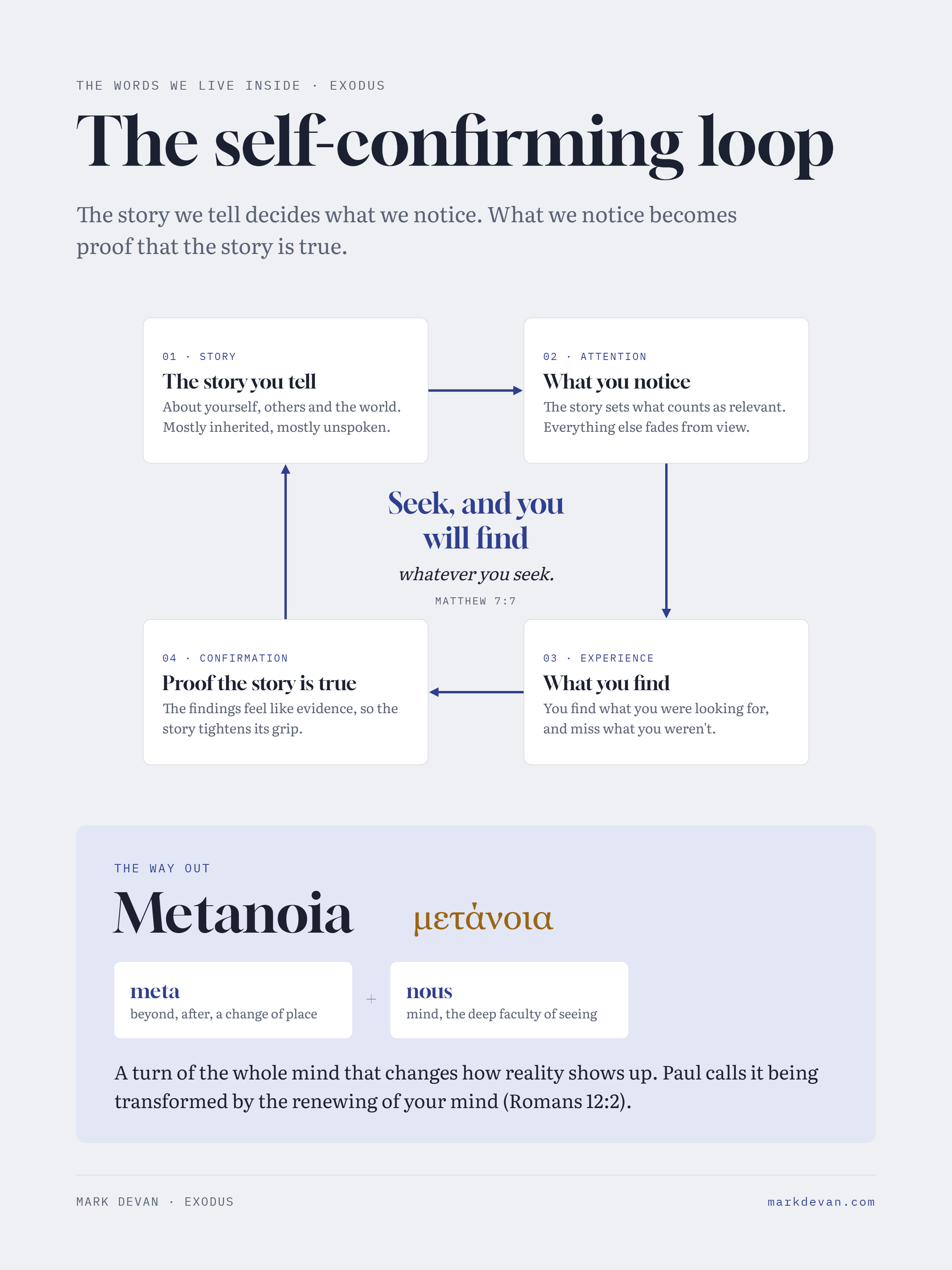
What are the stories that you tell yourself about yourself, others and the world around you? This is what determines what you pay attention to and in return what you find.
Jesus says seek and you will find, ask and it will be given, knock and it will be opened. What you are looking for will determine what you find.
Breaking out of this mental prison or narrative that plays in our unconscious requires a radical disruption or what is known in Greek as ‘metanoia’ – a radical change to the mind-body operating system. This is described across different religions as awakening, enlightenment, being born again, resurrection from the dead, becoming a new man, etc.
My story
I have spent most of my life working with words, shaping it to tell a story and carry a message that is meant to persuade, influence or warn. I have seen and studied how these stories shape and influence people to act and do things that they may not have previously thought about.
If the invention of the printing press resulted in the Reformation, I would not underestimate the impact of the internet, social media and AI on the future of humanity.
That is why George Orwell’s writing unsettles me. Almost 80 years ago he wrote about the power of words.
From fossils to forgeries
In a previous post, I explored Owen Barfield’s idea that words are fossils of consciousness. A word like spirit still carries the breath and wind it once meant. We keep using words long after we’ve forgotten what lives inside them, and they keep working on us.
Barfield looked backward. He read words as a record of how people once saw the world.
Orwell looks forward and asks a darker question. If words shape how we see, what happens when someone shapes the words on purpose?
- Barfield: words preserve a past consciousness. Recovery means waking up to what they once meant.
- Orwell: words can engineer a future consciousness. Resistance means refusing the ready-made phrase.
Language as psychotechnology
Language is a psychotechnology, a tool that trains how we attend, perceive and make sense of reality. It does this before we consciously reason about anything. That is exactly what makes it so powerful, and so easy to manipulate.
Dying metaphors
Here is the link between the two that surprised me. In “Politics and the English Language,” Orwell has a category he calls dying metaphors: worn-out figures of speech that people use without seeing the picture inside them anymore.
That is Barfield’s fossil seen from the other end. A dead metaphor no longer helps us see. It sees for us.
Orwell’s most famous examples were brutal. Villages bombed and their people driven out were described as “pacification.” Whole populations forced from their land became a “transfer of population.” The words were chosen so that nobody had to picture what was actually happening.
We still do it, just more politely:
- Right-sizing for sacking people.
- Collateral damage for civilians killed.
- Engagement for the hours an app has taken from you.
“The slovenliness of our language makes it easier for us to have foolish thoughts.”
George Orwell
Orwell saw that this works in both directions. Sloppy thinking produces sloppy language, and sloppy language then makes our thinking worse. He compared it to a man who drinks because he feels a failure, and then fails all the more because he drinks. It is a feedback loop, and we end up prisoners in our own minds.
Newspeak: how to make a thought extinct
If words are fossils, Newspeak is a deliberate mass extinction.
In George Orwell’s final masterpiece, Nineteen Eighty-Four, the Party’s new language gets smaller every year. The aim is not to ban dangerous ideas but to remove the words needed to think them. If there is no word for freedom, rebellion becomes not just illegal but unthinkable.
This is where Orwell goes further than the strong claim that language determines thought, which most linguists now reject. Our language does influence what we notice and what fades from view. Newspeak imagines what would happen if a regime pushed that influence as far as it could go.
If something cannot be named, it is hard to notice, harder to reflect on, and almost impossible to protect.
Doublethink: lying to ourselves, together
“War is peace. Freedom is slavery. Ignorance is strength.”
The Party slogan in Nineteen Eighty-Four
Doublethink is the ability to hold two contradictory beliefs at once and accept both. In the novel it is how the Party keeps its changing line infallible. Oceania is at war with Eurasia, then suddenly with Eastasia, and everyone is expected to forget it was ever otherwise.
What strikes me is that this isn’t just propaganda imposed from above. It is self-deception made socially shareable. A slogan lets a whole group stop noticing the same thing at the same time. Disagreement starts to feel personal, and nuance feels like betrayal.
Not just “over there”
We tend to use “Orwellian” for other people’s governments. Orwell would not let us off that easily.
He was a democratic socialist who aimed some of his sharpest warnings at his own side. He watched the British press, which had long been hostile to Stalin, change its tune almost overnight once the Soviet Union became a wartime ally. For Orwell, the Ministry of Truth didn’t need secret police. A free press willing to bend for political convenience would do.
The danger is always easiest to see in our opponents. Harder questions are closer to home:
- Advertising, where “natural” and “wellness” can mean almost anything.
- The workplace, where “efficiencies” and “change journeys” spare us from saying who loses their job.
- Religion, where insider language can signal belonging rather than describe reality, and words like “blessed” quietly come to mean “wealthy.”
- AI, which can now generate fluent, frictionless prose on demand. Orwell warned of ready-made phrases that think for us. We now have a machine that manufactures them.
Orwell’s six rules
Orwell ended his essay on Politics and the English Language with six simple rules for writing. They read like a style guide, but I think they are closer to a spiritual discipline.
- Never use a metaphor, simile or other figure of speech which you are used to seeing in print.
- Never use a long word where a short one will do.
- If it is possible to cut a word out, always cut it out.
- Never use the passive where you can use the active.
- Never use a foreign phrase, a scientific word or a jargon word if you can think of an everyday English equivalent.
- Break any of these rules sooner than say anything outright barbarous.
The point isn’t tidy prose. It is getting the picture clear in your mind first, then choosing the word. Don’t let the word decide.
An ancient discipline
None of this is new. Ancient traditions treated untrained speech as dangerous. Socrates slowed conversation down to patient questioning. Buddhism made right speech part of the path. The letter of James compares the tongue to a small rudder that steers a whole ship, and a small spark that sets a forest on fire.
In the Gospel of John, Logos doesn’t mean information. It points to the ordering principle that makes reality intelligible. Words were never neutral. They required discipline.
Newspeak narrows the mind until there is nothing left to see. The Greek word metanoia points the other way: a change of mind, a turning that takes us beyond the mind we have. Breaking out of the stories we tell ourselves takes nothing less.
“Seek and you will find.” But the real question is: what are you looking for? And who chose the words you are looking through?
3 questions
- Which phrases do I use that save me from picturing what I’m actually describing?
- Where do I spot doublespeak easily in others but miss it in my own tribe?
- Whose words am I thinking with?
Try it this week. Take one piece of jargon you used at work or church and rewrite it in plain words a child would understand. Notice what became harder to hide. Let me know what you find in the comments below.
Further reading
- Politics and the English Language – George Orwell (1946)
- George Orwell, Nineteen Eighty-Four (1949)
- Words are fossils of a forgotten way of looking at the world – my previous post
- Explore the power of language – an interactive artefact
- Owen Barfield, History in English Words (1926)
- John Vervaeke, Awakening from the Meaning Crisis (lecture series)
