

Have you ever felt that the more you fight your feelings the stronger they get? What if instead of trying to ignore or suppress them, you simply accept them.
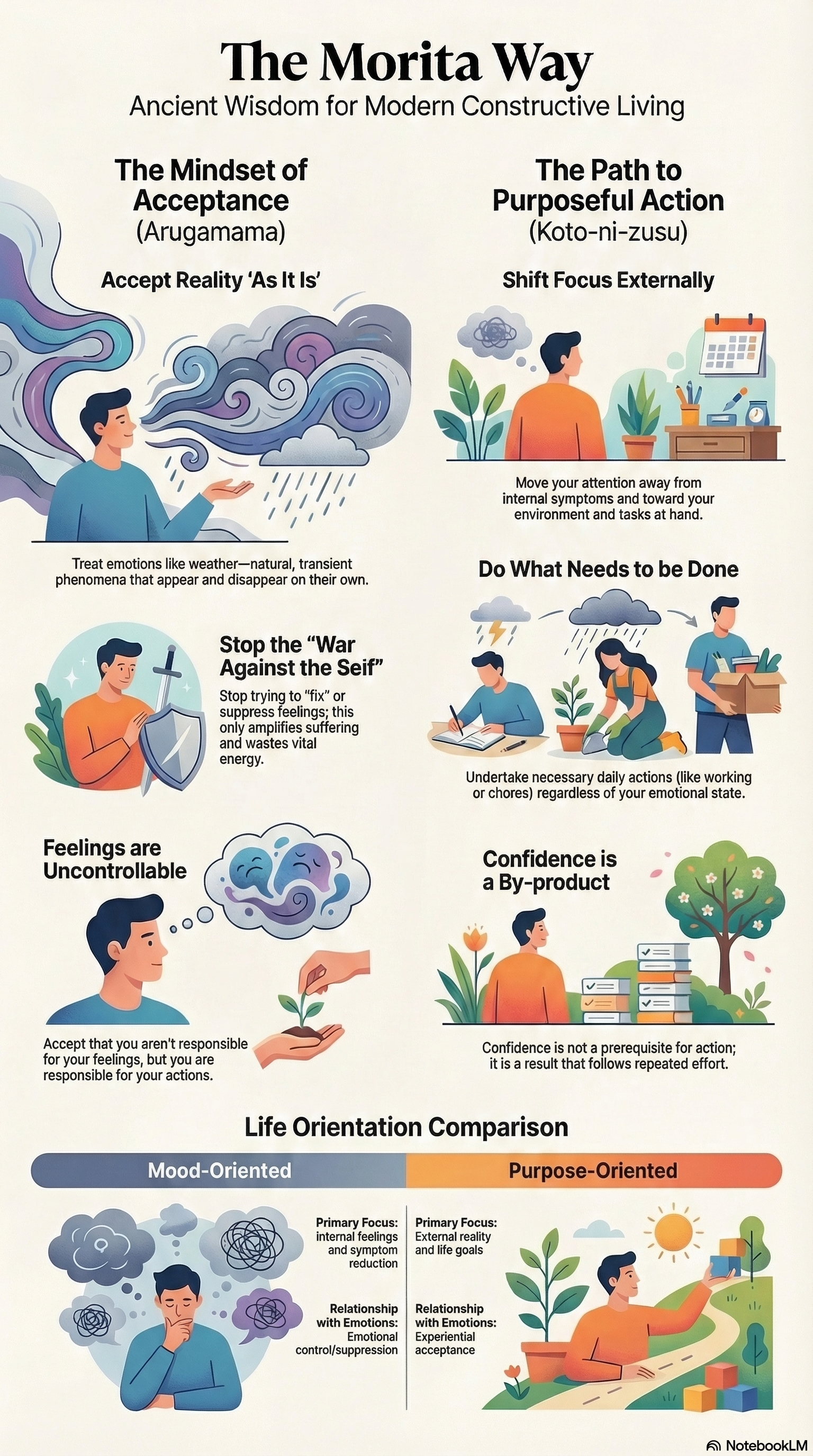
What if we treat our feelings and emotions as a transient, naturally occurring phenomena that appear and disappear just like weather patterns?
Here’s a radical different way to deal with anxiety. It’s called Morita Therapy. Developed in Japan over 100 years ago. It’s not about curing your nerves but outsmarting them.
Ancient Roots for Modern Stress
In the early 1900s, Dr. Shoma Morita realised that the more we focus on our internal “weather,” the stormier it gets. He combined the rigor of medicine with two powerful Japanese traditions:
- Zen Buddhism: The wisdom of accepting that life and our feelings are constantly changing.
- Shintoism: A deep connection to nature that helps us ground ourselves in the world around us.
Instead of digging into the past like Western psychoanalysis of his time, Morita looked at the now. He saw that anxiety often comes from a “desire for life”— a deep-seated wish to do well that unintentionally turns into a fear of failing.
Two Keys to Freedom
Morita Therapy boils down to two concepts that can change how you approach your feelings:
- Arugamama (Acceptance): This means letting your feelings be exactly what they are. If you feel anxious, feel anxious. Don’t waste energy trying to “push the river upstream”.
- Koto-ni-zusu (Purpose-Led Action): This is the game-changer. It says that while you can’t control your feelings with your will, you can control what you do. You don’t need to feel brave to take the step; you just need to do it.
Dive Deeper
I’ve put together a few resources to help you dig deeper into these ideas see how you can apply it:
Put It Into Practice Today
You don’t need a 10-step plan to start. You just need to shift your focus from feelings to action.
The next time you feel a wave of anxiety, don’t try to “fix” it. Notice the feeling, acknowledge it and then ask yourself: “What is the next small thing I need to do right now?” Then, go do it.

 Exodus