

And on the seventh day God ended His work which He had done, and He rested on the seventh day from all His work which He had done. Then God blessed the seventh day and sanctified it, because in it He rested from all His work which God had created and made.
Genesis 2:2-3
As the sun sets on Friday evening, Sabbath marks more than the end of the working week.
It is a symbolic return to Creation, where God rested and delighted in the goodness of the world; to the Exodus, where God’s people were freed from slavery and endless labour; to the New Covenant, which reminds us that we belong to God; and to the promised rest that lies at the heart of the Christian hope.
In setting apart this time, we allow these foundational realities to shape our mindset, bringing renewal, perspective and a deep sense of peace.
My journey into Sabbath
For the last 6 month, I have been making it a deliberate practice to observe the Sabbath. This ancient ritual provides me with the tools to find balance and rediscover meaning.
I was intrigued by Mircea Eliade’s concept of how Sabbath allows us to step out of ordinary time and into sacred time. I wanted to find out why this practice was such a big part of Jewish culture and the world of the Bible.
Why Sabbath is needed today
To live religiously is not merely to believe certain doctrines, but to inhabit a different kind of world.
Mircea Eliade
A clock does just measure time. It is a psychotechnology that teaches us to experience time in a particular way.
Where earlier cultures experienced time through sunrise and sunset, the seasons, festivals, sowing and harvesting of crops, each event seen as sacred, rhythmic, and filled with significance. The modern world meanwhile has reduced time to a uniform sequence of measurable units such as years, months, days, hours, minutes and seconds.
Sacred time did not disappear, but it was pushed to the margins. Sabbath, feast, and ritual became islands of meaning in an ocean of rigid schedules and to-do-lists.
The challenge for us today is not learning how to tell time, but relearning how to enter and inhabit sacred time.
A guide for practicing sacred time
Sabbath is an ordinary weekly discipline that allows anyone to reset their mind-body operating system.
Mircea Eliade’s The Sacred and the Profane is a foundational work in the study of religion. Its central aim is to explain how religious human beings experience, structure, and inhabit the world differently from modern secular people.
This section on practicing “Sacred Time” is based on his framework with references below for further reading
Understanding the shift
To practice sacred time, you must shift from “profane time”—which is linear, historical, and exhausting—to “sacred time,” which is cyclical and eternally recoverable.
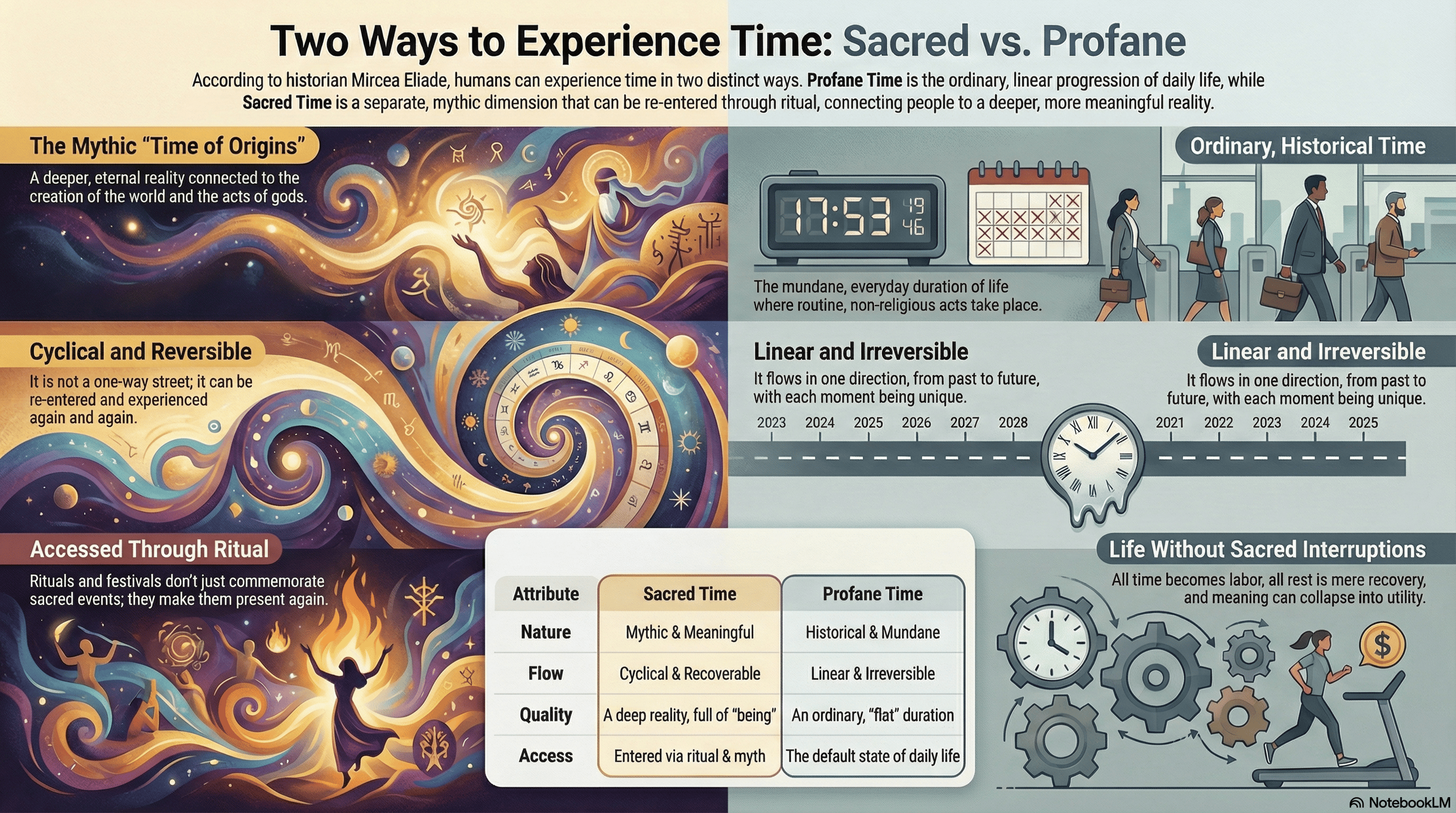
Ritual like Sabbath and festivals do not merely remember sacred events; it makes them present again, allowing you to re-enter illud tempus (“that time”), the time of origins.
The sacred cycle
The threshold: Friday sunset (15–20 minutes)
This marks your exit from ordinary time:
- Establish the scene: Put away the tools of labour like laptops and smartphones.
- The ritual: Light a candle to create a clear beginning.
- Opening prayer: Lord, as this Sabbath begins, help us cease from striving, delight in Your creation, and rest in Your presence. Amen.
Dwelling in the sacred: Saturday
The day is defined by four pillars: Stop, Rest, Delight, and Re-orient.
- Stop: Cease all work, studying, house cleaning, and checking your phone or email.
- Rest: Embrace sleep, guilt-free naps, and silence.
- Delight: Choose activities like slow nature walks, music or reading a hard copy book for pleasure.
- Reorient: Use prayer or reflection to remind yourself that your identity is not tied to your work.
I am not what I do, I am not what I own. I am not who people say I am. I am who I am. And that is enough.
The exit: Saturday sunset (10–15 minutes)
- Reflection: Quietly ask where you felt peace and what resisted rest.
- Closing prayer: Lord, thank You for this sacred time. As we return to our daily work, may Your peace remain with us and Your rest continue within us. Amen.
- Conclusion: Extinguish the candle to signal the return to ordinary time.
The 5 non-negotiables
- Consistency: Try to keep this a weekly practice.
- Repetition: Use the same opening acts (lighting candles and the prayer).
- No optimizing: Avoid trying to make the day productive.
- No catching up: Resist the urge to finish chores or work.
- Resilience: If you miss a week or break a rule, simply keep going.
How to escape linear time
The Lord’s Prayer – the procedure of presence
Our Source, hidden in the depths of the Unseen,

May the resonance of Your Name be set apart in my heart.

Let Your Way of Being become my reality;

Let Your intent be carried out through my hands on this earth,

Just as it is in the heart of the Infinite.

Provide for me today the specific sustenance I need for this moment.

Release me from the weight of my failures,

In the exact measure that I release others from the weight of theirs.

Do not let me wander into the places where I will be overwhelmed,

But rescue me from the grip of the Void.

For Yours is the Agency, the Presence, and the Radiant Weight of Reality,

In this moment and into the unfolding Always.

Amen.
Further Information & Resources
- Mircea Eliade’s Concepts:
- The Eternal Return (Wikipedia) — Overview of the belief in returning to mythic time through ritual.
- Summary of “The Sacred & The Profane” — Chapter-by-chapter summaries of Eliade’s work on sacred time.
- Academic Perspectives:
- Time of Origins: Charles Taylor & Eliade — An analysis of how modern subjects can re-engage the sacred.
- Sacred Time and Rabbinic Literature — Discussion on the relations between temporalities and sanctity.
- Liturgy and Cosmogony — Research on the ritual use of creation accounts.
- General Reading:
- “The Myth of the Eternal Return” (Bookey Summary) — Insightful exploration of archaic religions and modern experience.
Listen to the episode
This essay continues on the Exodus podcast in Episode 2: Sabbath, An Exodus from Work. Explore the full podcast journey.
